quiz
Choose one of the lectures below to start answering the questions
Choose one of the lectures below to start answering the questions
Choose one of the question types below to start answering the questions
Instructions
In the following practice, please pay attention to how you answer each question and how you feel your confidence in each answer will be.
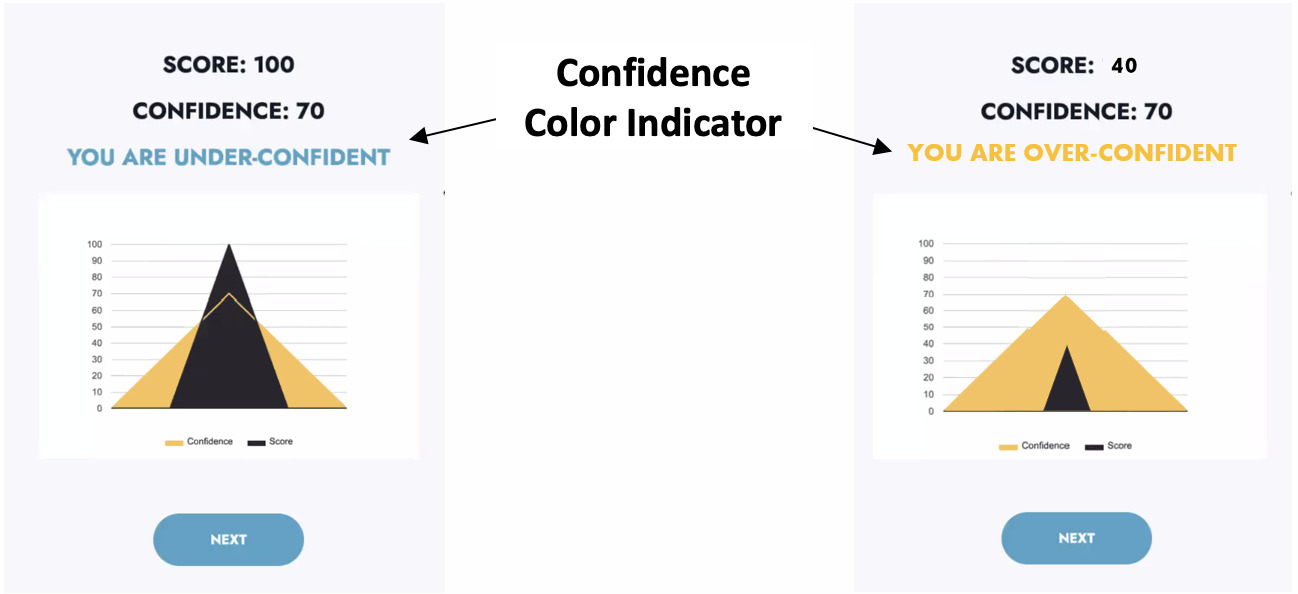
Your goal will be to try and reduce the distance between your confidence and actual score by obtaining as many Perfect Calibrations as possible.
You will receive feedback based on your performance and your confidence.
Scene 1
After you watch this module, please click the next button to answer the question
Please complete the sentence by filling in the blank
Occupational Biomechanics studies the physical interation of workers with their tools, machines, and materials to enhance the worker's performance while minimizing the risk of ( ).
How well do you think you have performed Question #1?
How well do you think you have performed Question #1?
0 -> I have zero confidence in my answer
100 -> I am very confident about my answer
Occupational Biomechanics studies the physical interation of workers with their tools, machines, and materials to enhance the worker's performance while minimizing the risk of ( ).
No solving procedure for this question
Scene 2
Move to the next spot, after you watch the next module, please click the next button to answer the question
Roughly what % of the information from scene #2 do you think you would be able to recall?
Please complete the sentence by filling in the blank
The force (F) required to move ( ) with an acceleration. Also, the moment (M) = Force x ( ).
How well do you think you have performed Question #2?
0 -> I have zero confidence in my answer
100 -> I am very confident about my answer
The force (F) required to move ( ) with an acceleration. Also, the moment (M) = Force x ( ).
No solving procedure for this question
Scene 3
Move to the next spot, after you watch the next module, please click the next button to answer the question
Roughly what % of the information from scene #3 do you think you would be able to recall?
Please complete the sentence by filling in the blank
Static equilibrium is about conditions for an object to remain at rest; when the sum of all forces and the sum of all moments acting on the body are ( ).
How well do you think you have performed Question #3?
0 -> I have zero confidence in my answer
100 -> I am very confident about my answer
Static equilibrium is about conditions for an object to remain at rest; when the sum of all forces and the sum of all moments acting on the body are ( ).
No solving procedure for this question
Scene 4
Move to the next spot, after you watch the next module, please click the next button to answer the question
Roughly what % of the information from scene #4 do you think you would be able to recall?
Please calculate the unknown force (F) in the free body diagram
A 10 kg stone sits on a see-saw 1 meter from the fulcrum. Where must a 2 kg stone sit in order to maintain static equilibrium?
How well do you think you have performed Question #4?
0 -> I have zero confidence in my answer
100 -> I am very confident about my answer
A 10 kg stone sits on a see-saw 1 meter from the fulcrum. Where must a 2 kg stone sit in order to maintain static equilibrium?
10 (kg) • 1 (m) = 10 (kg/m)
2 (kg) • x = 10 (kg/m)
x = 10 ÷ 2 = 5 (m)
Scene 5
Move to the next spot, after you watch the next module, please click the next button to answer the question
Roughly what % of the information from scene #5 do you think you would be able to recall?
What is the distance from the center of mass (forearm) to the shoulder?
How well do you think you have performed Question #5?
0 -> I have zero confidence in my answer
100 -> I am very confident about my answer
What is the distance from the center of mass (forearm) to the shoulder?
0.25 (m) + 0.2 (m) = 0.45 (m)
Scene 6
Move to the next spot, after you watch the next module, please click the next button to answer the question
Roughly what % of the information from scene #6 do you think you would be able to recall?
What is the moment caused by force acting on the upper arm?
How well do you think you have performed Question #6?
0 -> I have zero confidence in my answer
100 -> I am very confident about my answer
What is the moment caused by force acting on the upper arm?
18 • 0.12 = 2.16 (Nm)
Scene 7
Move to the next spot, after you watch the next module, please click the next button to answer the question
Roughly what % of the information from scene #7 do you think you would be able to recall?
Please complete the sentence by filling in the blank
According to Figure 4.3, the length from the shoulder to the upper arm's center of mass will be ( ) of the length of the upper arm.
How well do you think you have performed Question #7?
0 -> I have zero confidence in my answer
100 -> I am very confident about my answer
According to Figure 4.3, the length from the shoulder to the upper arm's center of mass will be ( ) of the length of the upper arm.
No solving procedure for this question
Scene 1
There isn't any question for this scene!
After you watch this module, please move to the next spot and click the next button to see the direction for scene 2
Scene 2
After you watch this module, please click the next button to answer the question
Roughly what % of the information from scene #2 do you think you would be able to recall?
Please complete the sentence by filling in the blank
In the first posture, his hands are parallel to the ground. In the second posture, his hands are at ( ) angle from the horizontal.
How well do you think you have performed Question #1?
0 -> I have zero confidence in my answer
100 -> I am very confident about my answer
In the first posture, his hands are parallel to the ground. In the second posture, his hands are at ( ) angle from the horizontal.
No solving procedure for this question
Scene 3
Move to the next spot, after you watch the next module, please click the next button to answer the question
Roughly what % of the information from scene #3 do you think you would be able to recall?
Please complete the sentence by filling in the blank
The weight of the hand is ( ), and the distance from the center of mass (COM) of the hand to the wrist is ( ).
How well do you think you have performed Question #2?
0 -> I have zero confidence in my answer
100 -> I am very confident about my answer
The weight of the hand is ( ), and the distance from the center of mass (COM) of the hand to the wrist is ( ).
70 (kg) • 0.006 = 0.42 (kg)
Scene 4
Move to the next spot, after you watch the next module, please click the next button to answer the question
Roughly what % of the information from scene #4 do you think you would be able to recall?
Please complete the sentence by filling in the blank
Distance from the wrist to elbow is ( ), and the distance from elbow to shoulder is ( ). Also, the angle of the trunk from the horizontal is ( ).
How well do you think you have performed Question #3?
0 -> I have zero confidence in my answer
100 -> I am very confident about my answer
Distance from the wrist to elbow is ( ), and the distance from elbow to shoulder is ( ). Also, the angle of the trunk from the horizontal is ( ).
No solving procedure for this question
Scene 5
Move to the next spot, after you watch the next module, please click the next button to answer the question
Roughly what % of the information from scene #5 do you think you would be able to recall?
Please complete the sentence by filling in the blank
The length of the forearm from the center of mass (COM) to the elbow is ( ), of the total length of the forearm. Also, the moment caused by the weight of the forearm is ( ).
How well do you think you have performed Question #4?
0 -> I have zero confidence in my answer
100 -> I am very confident about my answer
The length of the forearm from the center of mass (COM) to the elbow is ( ), of the total length of the forearm. Also, the moment caused by the weight of the forearm is ( ).
11.7 • 0.28 • 0.43 • cos(30) ≈ 1.22 (Nm)
Scene 6
Move to the next spot, after you watch the next module, please click the next button to answer the question
Roughly what % of the information from scene #6 do you think you would be able to recall?
What is the weight of the upper arm?
How well do you think you have performed Question #5?
0 -> I have zero confidence in my answer
100 -> I am very confident about my answer
What is the weight of the upper arm?
70 (kg) • 0.028 = 1.96 (kg)
Scene 7
Move to the next spot, after you watch the next module, please click the next button to answer the question
Roughly what % of the information from scene #7 do you think you would be able to recall?
Please complete the sentence by filling in the blank
The percentage of truck weight is ( ) of the total body weight. Also, the moment caused by the weight of the trunk is ( ).
How well do you think you have performed Question #6?
0 -> I have zero confidence in my answer
100 -> I am very confident about my answer
The percentage of truck weight is ( ) of the total body weight. Also, the moment caused by the weight of the trunk is ( ).
70 (kg) • 0.5 • 9.81 = 343.35
343.35 • 0.67 • 0.36 • cos(45) ≈ 58.49 (Nm)
Scene 8
Move to the next spot, after you watch the next module, please click the next button to answer the question
Roughly what % of the information from scene #8 do you think you would be able to recall?
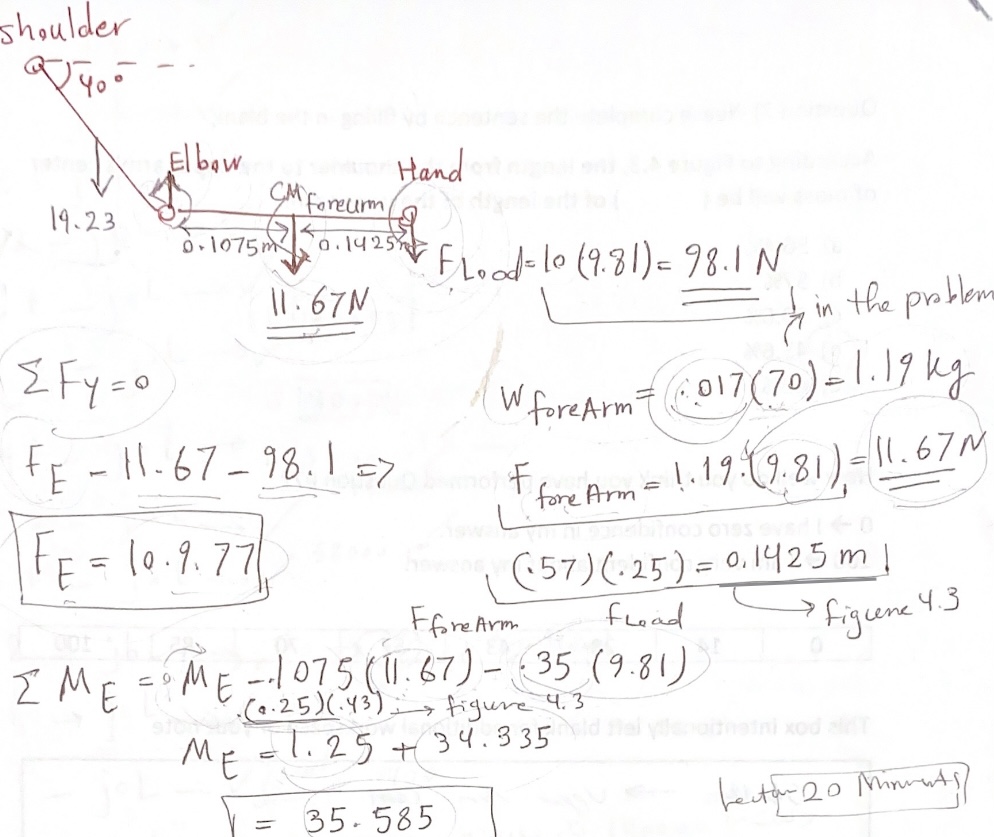
Determine the static forces (Fe) and moments (Me) at the elbow for the situation illustrated below where a small tool is held with one hand (neglect a hand mass). The tool mass is 10kg. A complete answer would include a free-body diagram (can be added to the existing diagram). The distance from the tool's center of mass (COM) to the wrist is 0.1m. The length of forearm is 0.25m. Total body weight is 70kg.
How well do you think you have performed Question #7?
0 -> I have zero confidence in my answer
100 -> I am very confident about my answer
If you have any questions, please feel free to ask the research assistant
Reflect on why you felt your answer was not correct: (click all that apply)